Common Challenges in Reviewing sourcing service proposals
A sourcing service proposal is difficult to compare when it promises broad help without defining activities, deliverables, decision rights, fees, or exclusions. Buyers should connect each promised outcome to a named owner, method, record, timing, and acceptance measure. A clear proposal makes it easier to understand who does what and how performance will be reviewed.
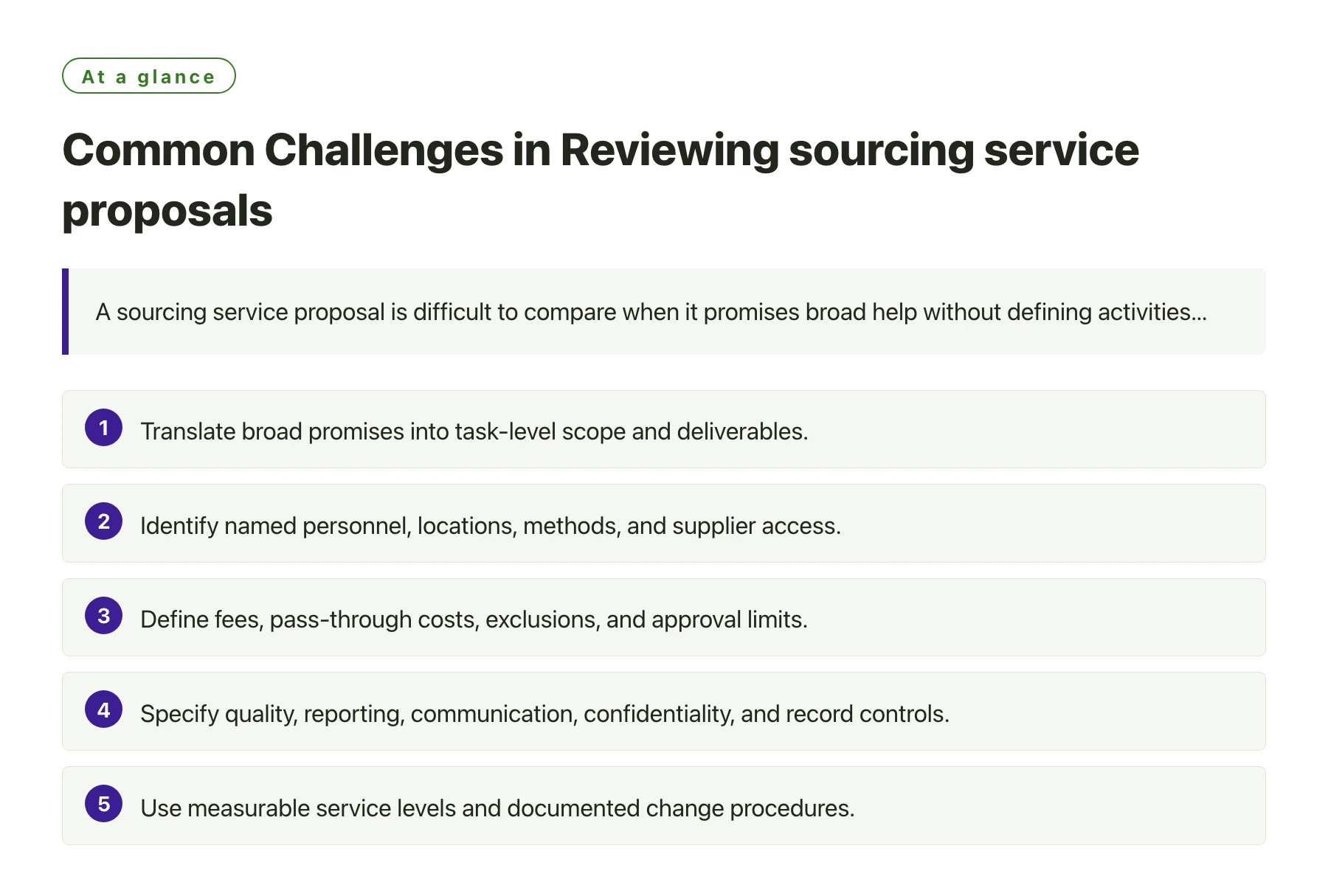
Key takeaways
- Translate broad promises into task-level scope and deliverables.
- Identify named personnel, locations, methods, and supplier access.
- Define fees, pass-through costs, exclusions, and approval limits.
- Specify quality, reporting, communication, confidentiality, and record controls.
- Use measurable service levels and documented change procedures.
Review the proposal as an operating plan: each service promise should map to a specific activity, output, and accountable decision maker.
1. Define the business need and service boundaries
Describe products, target suppliers, markets, expected order frequency, quality concerns, and desired outcomes. State which activities are required now and which may be added later. A supplier-search engagement differs from ongoing production management, inspection coordination, or logistics follow-up.
Ask the provider to list included tasks and explicit exclusions. Clarify whether the service covers research, outreach, factory visits, quote comparison, sample handling, translation, inspection booking, document review, shipment tracking, or issue escalation. Avoid relying on labels such as full service without an accompanying work description.
2. Convert activities into deliverables
For each task, define output, format, due date, required information, and acceptance condition. Examples include a supplier shortlist with screening evidence, a normalized quotation matrix, sample log, inspection report, action register, or shipment status record. State who reviews and approves each output.
Distinguish activity from outcome. Making calls or arranging visits is an activity; a documented finding or completed comparison is a deliverable. Avoid performance promises that depend on buyer decisions, supplier cooperation, customs, or market factors outside the provider’s control.
3. Examine supplier verification methods
Ask how potential suppliers are identified and what checks are performed on legal identity, production site, product capability, export experience, capacity, quality controls, and subcontractors. Request an example report with confidential information removed. Find out how evidence is dated, sourced, and tied to the factory or product.
Clarify whether a directory search, remote interview, factory visit, audit, or product test is included. Each method supports different conclusions. Do not treat a basic company profile or site visit as proof of regulatory compliance, manufacturing capability, or future performance.
4. Check quality and corrective-action scope
Specify whether the provider coordinates reference samples, inspection plans, inspectors, laboratory testing, production checks, or shipment release. Identify who sets technical criteria, who decides pass or fail, and who pays for reinspection, retesting, travel, or corrective work.
ISO 9001 describes quality management system requirements and continual improvement. If a proposal claims certification, verify issuer, scope, site, and validity. Certification does not by itself guarantee a supplier’s product or the quality of the proposed service; request relevant process and performance evidence. [1]
5. Identify the team and decision authority
Request named roles, relevant experience, language capability, local coverage, workload, backup contacts, and escalation path. Ask who will perform supplier visits and whether subcontractors or affiliates may be used. Confirm responsibility for conflicts of interest and any supplier referral compensation.
Define what the provider may decide independently and what requires buyer approval. Typical approval gates include supplier selection, specification changes, sample acceptance, commercial concessions, inspection disposition, payment, and shipment release. The provider should not imply authority the buyer has not granted.
6. Normalize fees and pass-through costs
Compare fixed, hourly, project, retainer, order-value percentage, or per-visit fees using the same expected workload and term. List travel, translation, sample shipping, testing, third-party inspection, taxes, and expenses separately. Clarify minimum charges, overtime, cancellation, currency, payment timing, and any success fee.
Ask how additional work is approved and billed. A low headline fee may exclude essential travel or inspection coordination; a percentage fee may change as order value rises. Model likely and high-use scenarios, including repeat orders and supplier problems.
7. Review data, confidentiality, and record ownership
Define ownership and permitted use of drawings, supplier lists, samples, quotes, reports, photographs, and contact data. Set confidentiality expectations and limits on reusing buyer information with other clients. Specify secure transfer, access, retention, return, and deletion when the service ends.
Clarify whether the buyer can directly contact suppliers, receive original quotations, access inspection records, and transfer work to another provider. A transparent record trail reduces dependency and supports later audits, warranty claims, and repeat procurement.
8. Set communication and performance measures
Agree on meeting cadence, response time, report format, language, urgent escalation channel, status definitions, and time zone coverage. Set service measures that the provider can influence, such as milestone reporting timeliness, completeness of supplier evidence, quote normalization, issue escalation, and action closure.
Define measurement period, data source, exclusions, and reporting owner. Avoid vague satisfaction targets or unrealistic guarantees on supplier acceptance, savings, or delivery. Review performance with examples and corrective actions when expectations are missed.
9. Check term, exit, and continuity provisions
Review term, renewal, termination notice, handover duties, open order support, refund conditions, liability allocation, dispute process, and governing contract documents with appropriate advisers. Identify how quickly records, samples, supplier status, and open actions will be transferred if the engagement ends.
Ask what happens if the assigned person becomes unavailable or a supplier dispute arises. Continuity requires accessible records, backup coverage, and clear ownership of active decisions, not only a general promise of ongoing support.
10. Compare proposals and approve a pilot
Build a matrix for scope, deliverables, method, team, fees, exclusions, controls, reporting, performance measures, and exit terms. Screen for mandatory capabilities first, then score preferences. Document assumptions and unanswered questions before negotiation.
Consider a defined pilot with a small supplier search, quote comparison, or order coordination task. Set success criteria and review the actual reports, communication, issue handling, and total cost. Buyers considering JS Sourcing sourcing support in China should approve a proposal only when scope and decision rights are explicit enough to manage.
Sources
Frequently asked questions
What is the most important part of a sourcing proposal?
A clear scope that links specific tasks to deliverables, owners, timing, fees, and approval responsibilities.
Does a supplier audit guarantee future product quality?
No. An audit reviews defined systems or processes at a point in time; product and lot checks may still be needed.
Should travel and testing fees be included in the service fee?
List them separately and state when they apply, how they are approved, and who pays third parties.
How can buyers compare service providers fairly?
Use one scope, compare methods and outputs, normalize fees and exclusions, and check evidence and references.